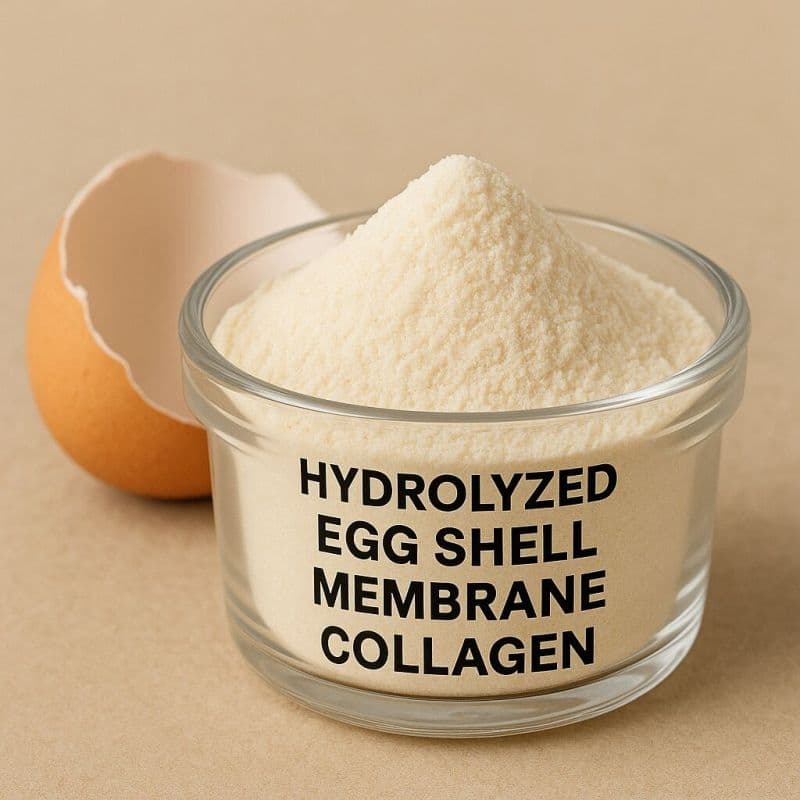
Most collagen supplements on the market are sourced from bovine or marine hide and bone. Eggshell membrane collagen is a different, less commonly discussed source — and it comes with a naturally occurring composition that's difficult to replicate synthetically.
What's Actually in Eggshell Membrane
The thin membrane lining an eggshell is rich in structural proteins, and hydrolysis (enzymatic breakdown for bioavailability) reveals a naturally occurring mix:
- Type I collagen — the most abundant type in the membrane, found in the larger structural fibers.
- Type V collagen — associated with the finer fibers within the membrane structure.
- Type X collagen — found in both membrane layers, thought to play a role in preventing mineralization.
Beyond collagen, the membrane also naturally contains glycosaminoglycans (including hyaluronic acid precursors) and additional structural proteins and minerals — which is part of why it's studied as a joint-support ingredient rather than a single-molecule extract.
Why This Matters for Formulators
Single-source, naturally co-occurring collagen types and glycosaminoglycans are harder to replicate by blending isolated ingredients. For brands positioning a product as "whole food" or minimally processed collagen, eggshell membrane offers a genuine point of differentiation from standard bovine/marine collagen peptides.
Common Applications
- Joint health supplements — capsules and tablets targeting mobility and joint comfort
- Skin and beauty supplements — leveraging the same collagen/GAG matrix for skin elasticity claims
- Sports nutrition — as a joint-support addition alongside standard protein/recovery formulations
- Functional foods — where a "natural collagen source" ingredient line is more marketable than an isolated peptide
Formulation Notes
Hydrolyzed eggshell membrane is typically supplied as a powder for capsule or tablet formulation. Since it's a natural-source ingredient rather than a synthesized single compound, batch consistency depends heavily on supplier processing control — ask for COA data per batch, not just a general spec sheet.
Sourcing Checklist
- Confirm hydrolysis method (enzymatic vs acid) and resulting bioavailability data
- Ask for a breakdown of collagen type composition, not just "contains collagen"
- Verify food/nutraceutical-grade certification (FSSAI, ISO 22000) on the processing facility
- Check minimum order quantities — eggshell membrane collagen is a specialty ingredient, and MOQs are typically lower than bulk egg powders
For brands looking to differentiate a joint or skin health product from the standard bovine collagen crowd, eggshell membrane collagen is worth a formulation trial.