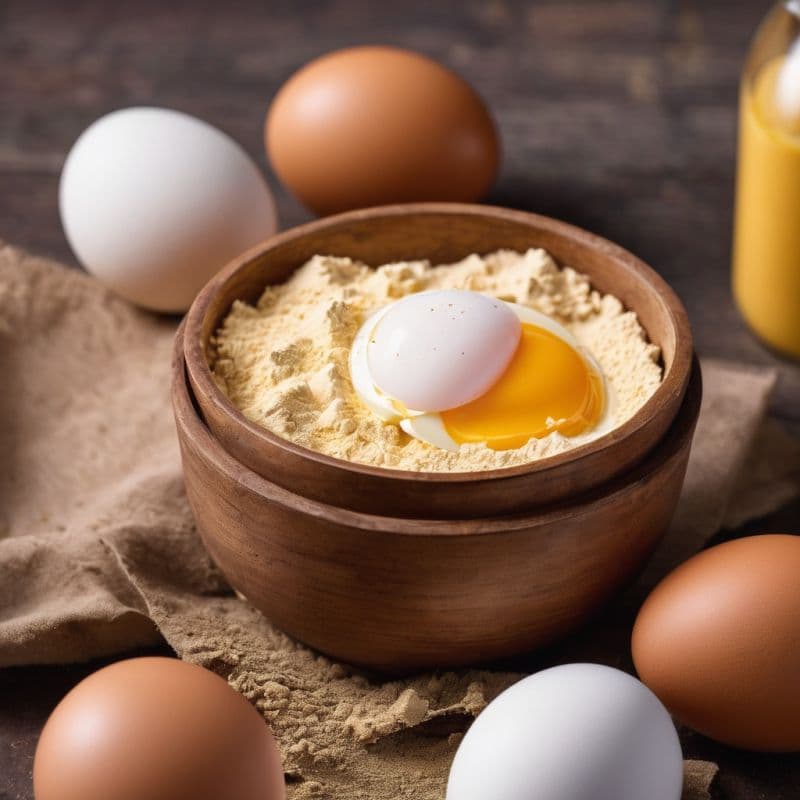
For a home kitchen, fresh eggs are the obvious choice. For a food manufacturer running a production line, the calculation is different — and it usually favors egg powder. Here's how the two compare on the factors that actually matter at scale.
Consistency
Fresh eggs vary by hen age, breed, season, and feed — which means moisture content, protein density, and yolk color shift from batch to batch, even from the same supplier. Spray-dried egg powder is standardized to a fixed specification (moisture, protein, solubility), so every batch performs identically in your formulation. If your product needs to taste and behave the same in July as it does in January, that consistency isn't optional.
Storage and Shelf Life
Fresh eggs require unbroken refrigeration from farm to factory floor — every link in that chain is a point of temperature abuse and spoilage risk. Egg powder is shelf-stable at ambient temperature for 6+ months, which removes cold-chain cost and risk entirely. For manufacturers without cold storage, or those shipping ingredients internationally, this alone can be decisive.
Food Safety
Shell eggs carry a recognized Salmonella risk. Properly pasteurized egg powder (typically pasteurized at 62–65°C before spray drying) eliminates vegetative pathogens while preserving the functional proteins your formulation depends on — emulsification, aeration, and coagulation all remain intact.
Labor and Handling
Cracking eggs by hand at scale is slow, generates shell waste, and is the highest cross-contamination point on a production floor. Powder eliminates cracking entirely — it doses directly into your existing mixing systems.
Where Fresh Eggs Still Win
Fresh eggs remain cheaper on a pure ingredient-cost basis in some markets, and some artisanal or clean-label positioning specifically calls for "whole shell eggs" on the ingredient list. If your formulation and labeling strategy require that, egg powder isn't a drop-in replacement — it's a reformulation decision.
The Bottom Line
For high-volume, multi-batch production where consistency, shelf life, and food safety matter more than raw ingredient cost, egg powder is the practical choice. It's not about eggs being "better" in the abstract — it's about which format actually works at your scale.